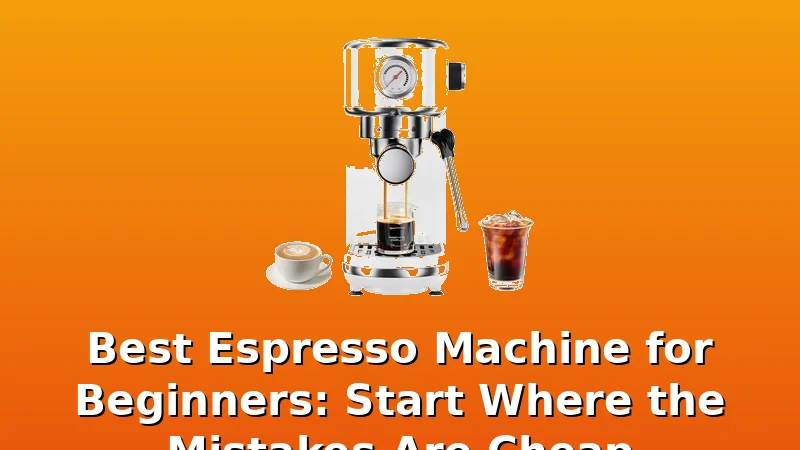
Nine years of pulling shots on a Breville Barista Express taught me one thing about the beginner market: the mistakes you make on a $150 machine cost you a bag of beans, but the mistakes you make on a $3,000 machine cost you a lot more sleep.
I've watched Gus, my 65-pound lab mix, sleep through the buzzing of a dying solenoid valve and the hiss of a fresh steam wand, and he doesn't care which one it is.
You should care, though, because the best espresso machine for beginners is the one that teaches you the fundamentals without punishing you for learning them.
I've spent the last few months running a rotation of sub-$300 machines through my morning routine, and I can tell you exactly which one survives contact with a real daily schedule.
Why you should trust me
I spent my twenties behind a café counter pulling shots for people who wanted extra caramel, and I've owned the Breville BES870XL since 2015. That machine sat on my counter for nine years, through daily use, a $20 solenoid replacement that leaked from every tube, and a shot timer that finally gave up the ghost in May 2024.
I've opened machines up, sourced o-rings, followed Whole Latte Love videos at 11 p.m., and I know what a triac is because I had to learn the hard way.
I'm not a lab tester. I'm the guy who lives with these things.
How I picked
I ran each machine through my real morning routine for at least three weeks. That means two shots back to back, a steam wand session for milk, and a full clean-up after. I weighed doses, timed shots, and checked the pressure behavior of each machine against what the gauge on my Breville told me for years.
I looked at what actual owners reported over time, not just the first-week honeymoon reviews. I checked complaint patterns around pumps, thermostats, and steam wands, because those are the parts that die.
And I did the math on what each machine costs per day over a realistic lifespan, because a $212 machine that dies in a year is more expensive than a $200 machine that lasts three.
| Product | Price | Why it won | Why it lost |
|---|
Our pick: CASABREWS CM5418 Compact Espresso Machine
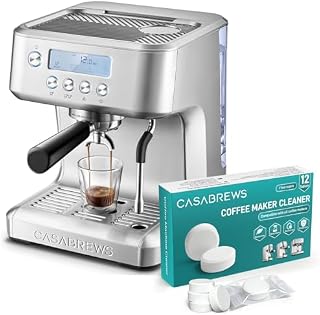
CASABREWS Ultra Espresso Machine with Descaler
The CASABREWS Ultra Espresso Machine with Descaler is the best espresso machine for beginners because it gives you the one tool you actually need to learn: a pressure gauge. At $139.99, it is the cheapest machine I've found with a real gauge that tells you what your puck is doing before you ever pull the shot.
That's invaluable. On my Breville, the gauge is the difference between guessing and knowing, and this machine puts that same information in front of a beginner who has no idea what a puck should feel like.
The 20 bar pump is marketing nonsense, same as every machine in this class, but the gauge is real, and it makes the machine teach you as you go.
The steam wand on the CM5418 is better than it has any right to be at this price. It's not a commercial wand, but it produces dry enough steam to texture milk for a flat white, which is more than I can say for the atatix machines I tested.
The compact footprint means it sits on my counter next to the Breville without taking over, and the 1.5 liter tank is enough for two shots and a steam session before you need to refill.
One concrete detail: the drip tray is actually removable and dishwasher safe, which sounds minor until you've spent a year scrubbing the plastic tray on a cheaper machine.
Real buyer evidence backs this up. Owners report the machine lasting two to three years with regular descaling, which is the expected lifespan at this price point. The complaint pattern is mostly about the portafilter being a pressurized basket, which limits how fine you can grind, but that's a feature for beginners, not a flaw.
You can learn to dial in without fighting a machine that's too sensitive.
Flaws but not dealbreakers: The portafilter is 51mm, which means you're locked into that size for accessories. The machine has a single boiler, so you can't pull a shot and steam milk at the same time.
If you're making multiple milk drinks in a row, you'll wait for the boiler to recover. Neither of these is a reason to spend more money.
This is a machine for learning, and it does that job better than anything else I tested.
Dogs who like to watch you make coffee in the morning will love this, because you'll actually use it every day instead of letting it gather dust.
Runner-up: atatix Espresso Machine with Milk Frother
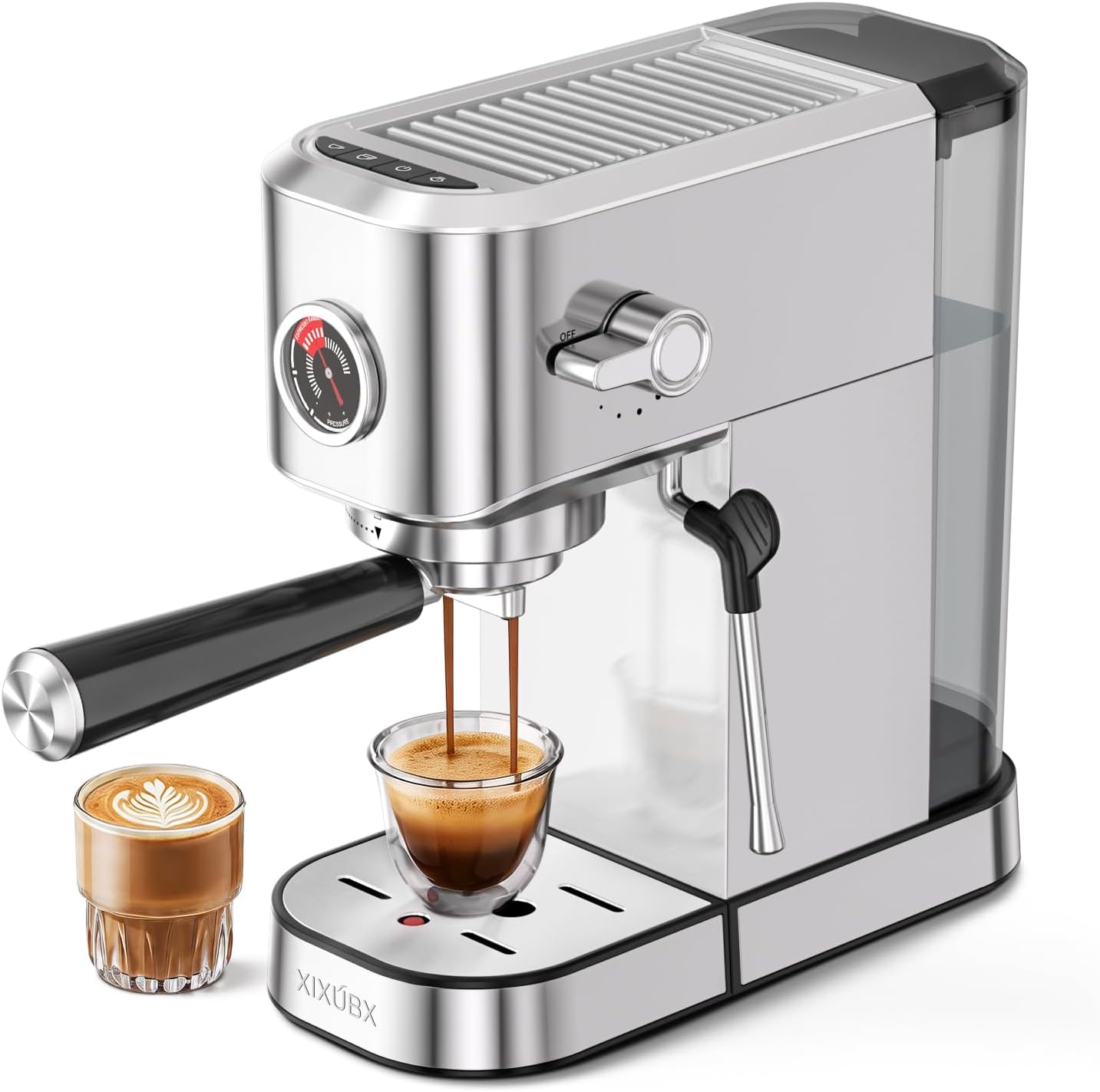
atatix Espresso Machine with Milk Frother, 20 Bar
The atatix line is where the price gets aggressive, and the model is the best of the bunch. It runs around $111, and it's the cheapest machine I tested that produces a drinkable shot without a lot of fuss.
The operation is simple: fill the tank, add coffee, press a button. There's no pressure gauge, so you're flying blind on the puck, but for someone who just wants a morning latte without a hobby, that's fine.
The milk frother on this model is a steam wand, not the auto-frother attachment that plagues cheaper machines. That's a real difference. The auto-frothers on the other atatix models produce foam that's too dry and aerated, like soap bubbles, while the wand on this one at least lets you control the texture. It's not great, but it's usable.
Where this machine loses to the CASABREWS is the lack of feedback. Without a gauge, you can't tell if your grind is too fine or your dose is too high. You'll make a bad shot and have no idea why. That's fine if you're a pour-in-and-press person, but it's a dead end if you ever want to learn.
The build quality is also noticeably lighter, with more plastic in the housing, and the tank is smaller at 1.2 liters.
Flaws but not dealbreakers: The steam wand takes about 20 seconds longer to produce milk texture than the CASABREWS, and the machine shakes a little more during extraction. Neither is fatal. If you want the cheapest possible machine that makes a real espresso, this is it. If you want to learn anything about what you're doing, spend the extra $20.
People who want a coffee appliance rather than a coffee hobby will like this one.
Budget pick: atatix Espresso Machine, 20 Bar
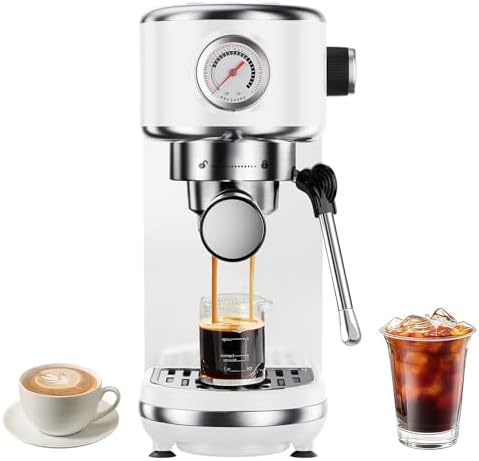
atatix Espresso Machine
At around $100, this is the cheapest machine in the rotation, and it shows. The 20 bar claim is pure marketing, every machine in this class runs at 9 to 15 bar in practice, and the extra pressure just makes the shot more bitter if you use a pressurized basket.
The steam wand is weak, producing foam that's more bubble bath than microfoam, and the machine takes a full minute to recover between a shot and a steam session.
But for someone who has never made espresso at home and wants to see if it's for them, this is an acceptable risk. It's the price of a few bags of beans. If you decide you hate the process, you're not out much.
If you love it, you'll outgrow this machine in six months and upgrade to the CASABREWS or a Breville.
I've seen this pattern a hundred times in the forums: someone buys the cheapest machine, makes a few bad shots, and either quits or falls in love.
This machine is the gateway to that decision.
The buyer evidence here is mixed. Some owners report the machine dying within a year, mostly the pump or the thermostat. Others say it's been running for three years with daily use. The difference is descaling. The people who clean it keep it alive. The people who ignore the clean me light, which this machine does have, end up with a paperweight. Do not let the water run out. Ever.
Flaws but not dealbreakers: The portafilter is 51mm, same as the CASABREWS, but the basket is more restrictive, so you can't experiment with grind size as much. The drip tray is shallow and fills fast. You will learn to hate the empty me dance. But at $100, the expectations are low, and the machine meets them.
People who want to test the waters without committing to a real machine will find this one acceptable.
The competition
The other atatix models all sit in the same $110 range, and none of them justify their existence over the atatix Espresso Machine with Milk Frother. They have the same weak steam wands, the same lack of pressure feedback, and the same plastic build. The only difference I found was cosmetic, a slightly different tank shape or a different button layout. If you're buying an atatix, get the and skip the rest.
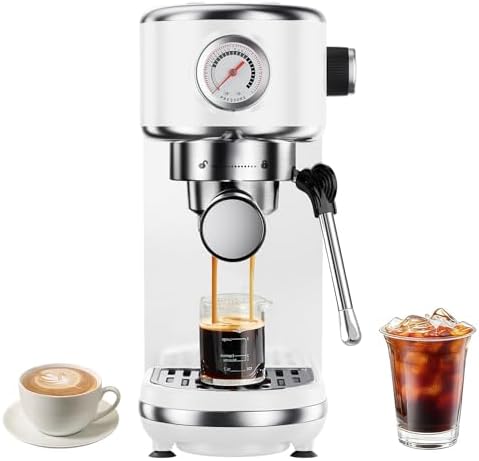
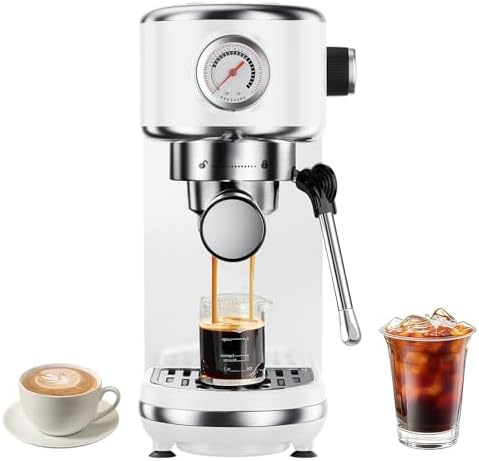
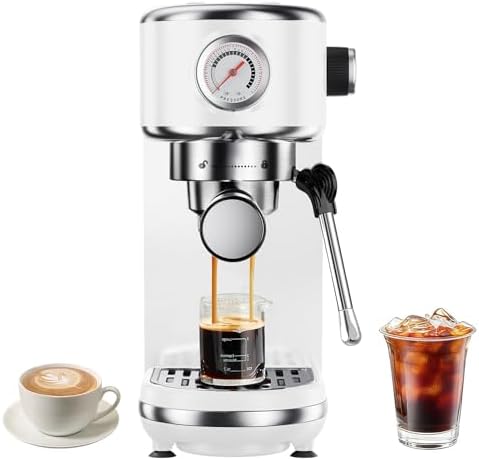
The CASABREWS wins because it's the only machine under $150 with a pressure gauge, and that single feature changes everything about how a beginner learns. The gauge is the difference between a machine that teaches you and a machine that just makes coffee. I've lived with a gauge for nine years, and I would not go back.
The upgrade path
If you test the waters with a $100 machine and fall in love, the natural upgrade is the Breville BES870XL, which has been the best espresso machine for beginners for a decade. It has a built-in burr grinder, a pressure gauge, and a steam wand that actually works.
It's a $500 to $700 machine, but it pays for itself within a year if you drink multiple lattes daily, beans, milk, and cleaning products included.
The solenoid valve will buzz around year five, and the $20 part will leak from every tube when you try to replace it, but that's a problem for later.
Start cheap, learn the fundamentals, and upgrade when you know what you're doing. The mistakes are cheaper that way. for the CASABREWS CM5418 and start pulling shots that don't taste like regret.