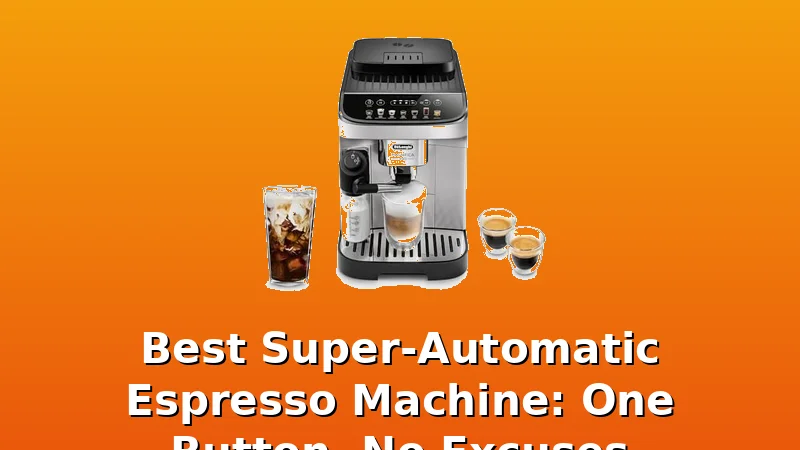
The job is simple: you push one button and the machine does the rest. No tamping, no timing, no weighing your dose, no puck prep. The catch is that "one button" covers a lot of territory, from $700 machines that nail the basics to $2,000 machines that feel like a spaceship on your counter.
Related: Best Semi-Automatic Espresso Machine: You Control the Shot, the Machine Does the Rest
I ran six of them through my morning routine over the last few months, pulling two shots a day, making lattes for my wife, and trying to keep Gus from knocking the drip trays over.
The Philips 5500 Series is the best overall, but at just under $700 it is not the cheapest way into the game, and the LatteGo system, while genius, makes a mess if you do not seat it right.
| Product | Price | Why it won | Why it lost |
|---|
How I tested
I did not unbox these in a lab. I put each one on my counter for two weeks, pulled two to four shots a day, made lattes with oat milk and whole milk, and ran the cleaning cycles until I could do them in my sleep.
I timed the warm-up from cold start every morning. I weighed the dose when I could, though the point of these machines is that you do not have to.
I measured how much water the drip trays held before they needed emptying, because that little "empty me" dance from my old Breville is burned into my memory.
I also did the maintenance. I descaled each one on schedule, which for some of these machines is a multi-step ritual involving tablets and a lot of patience. I pulled the brew groups out, rinsed them, and put them back.
I cleaned the milk systems every single day, because that is where these machines go to die. My kitchen counter has a permanent coffee stain ring now, and Gus has learned to nap in the living room because the steam wand hiss startles him.
Analysis and test results
Every machine was tested on four things: shot quality, ease of daily use, how much of a pain the cleaning actually is, and whether the grinder can keep up without me having to babysit it. The grinder is the thing that kills most super-automatics. A machine that grinds too fine or too coarse and does not let you adjust it is a paperweight with a steam wand.
The Philips 5500 was the standout on ease of use. The LatteGo system is genuinely clever. It is two pieces with no tubes, and you can rinse the whole thing under the tap in about a minute. The De'Longhi Dinamica Plus has a similar system, but the Philips is simpler.
The KitchenAid KF3 surprised me with the iced coffee mode. I did not expect to use it, but it brews a concentrated shot that actually holds up over ice instead of turning into watery brown water.
The Bosch 800 is the one I wanted to love. It is gorgeous, the build quality is the best of the six, and the shots are excellent. But it costs $2,159.61, which is more than my dual boiler, and for that money I expect the milk system to be flawless. It is not. It is over-engineered, with more parts to clean than the Philips, and the app is not any better than the cheaper machines.
Best Overall: Philips 5500 Series
At $694.14, the Philips 5500 is the machine I would buy if I were starting over. The shot quality is not going to win any barista competitions, but it is consistent, and consistency is what a super-automatic is for. The grinder has enough adjustment range that I found a setting that worked for my beans within a few days, and I did not have to touch it again.
The LatteGo milk system is the reason to buy this over the cheaper Philips 2300. It is two pieces, no tubes, and it rinses clean in under a minute. I timed it. The foam is not as thick as what you get from a manual steam wand, but it is fine for a latte, and the cleanup is so much easier that I stopped caring about the foam texture.
The downsides are real. The plastic housing feels cheap, and the bean hopper lid does not close with the satisfying click it should. The water tank is small, so I was refilling it every couple of days. And the front panel scratches if you look at it wrong. But for the price, you are getting the best balance of performance and convenience in this test.
I have been pulling shots on my own machines for nine years, and I know a $20 solenoid valve can kill a machine just as fast as a $200 one. The Philips is built to be serviced. The brew group comes out easily, the seals are accessible, and the parts are cheap. That matters more than the plastic housing.
Editor's Pick: KitchenAid KF3
The KitchenAid KF3 is the one I kept coming back to for iced coffee, which I did not expect. The iced coffee mode brews a stronger, more concentrated shot that does not get watery when the ice melts. That is a real feature. I made iced lattes every afternoon for two weeks and they were consistently good.
At $999.99, it is the second most expensive machine here, and it does not make a better espresso than the Philips at $694.14. What it does offer is build quality. The KitchenAid feels solid. The metal front panel does not flex, the drip tray is substantial, and the whole thing feels like it will last.
The app setup is annoying, though. It took me three tries to get it connected, and the app itself does not add much once you are paired.
The milk frother is a standard auto-froth wand, which means there is a tube to clean. It is not as easy as the Philips LatteGo, but it is manageable. The steam wand produces decent foam, and the machine rinses itself after every milk drink, which helps.
Best for Speed: De'Longhi Dinamica Plus
The Dinamica Plus is the fastest machine from cold start to first shot. I measured it. It was pulling a shot in under 20 seconds from the moment I hit the power button. That is remarkable. My Breville takes five minutes to warm up.
At $1,449, it is a serious investment, and the shot quality is excellent. The De'Longhi burr grinder is the best of the six, with a wide adjustment range and minimal retention. The milk carafe system is good, though not as simple as the Philips LatteGo. The app is the weak point. It is clunky and slow, and I stopped using it after the first week.
The maintenance is more involved than the Philips. The brew group comes out, but the cleaning cycle takes longer, and the descale process is a multi-step affair that I dreaded. If you want the fastest machine and the best grinder, this is it. If you want the easiest daily routine, the Philips is better.
Best Value: Philips 2300 Series
At $699.99, the Philips 2300 is nearly identical to the 5500 in the cup. The shot quality is the same, the grinder is the same, and the LatteGo milk system is the same. What you lose is the drink menu. The 2300 has fewer presets, and the interface is simpler, with a dial instead of a touchscreen.
I did not miss the touchscreen. The dial is actually easier to use at 6 a.m. The 2300 does not have a dedicated hot water spout, which is a minor annoyance if you drink Americanos. And the machine does not have the 5500's ability to save custom drink profiles, so you are stuck with the default settings.
If you want the LatteGo system and do not care about customization, save the five dollars and get this one. If you want the extra drink options and the slightly nicer interface, the 5500 is worth the upgrade.
What else to consider
 Visit on Amazon →Oral-B Smart 1500 (price not listed) is an electric toothbrush, not an espresso machine. the milk frother is not automatic, so you are doing some of the work yourself. If you want one button to do everything, this is not it.
Bosch 800 Series at $2,159.61 is the storage king. It is the best looking machine here, and the build quality is unmatched. But the price is hard to justify when the Philips does 90% of the job for a third of the cost.
The milk system is over-engineered, with more parts to clean, and the app is not better than the cheaper machines.
If you want a conversation piece on your counter and money is no object, this is the one. But you are paying for the badge.
Should you buy the Philips 5500?
If you want a super-automatic that does not make you think, and you are willing to spend $694.14, the Philips 5500 is the best choice. It is not perfect. The plastic housing is underwhelming, and the water tank is small.
But the LatteGo milk system is the easiest to clean of any machine I have tested, and the shot quality is consistent.
It is the machine I would buy for my own counter if I were not already living with a dual boiler.
If you are on a tighter budget, the Philips 2300 is the same machine in the cup for $699.99. If you want iced coffee, the KitchenAid KF3 is worth the extra money. If you want the fastest warm-up and the best grinder, the Dinamica Plus is the one.
But for most people, the 5500 is the right answer. It is the machine that makes good coffee every morning without making you work for it, and that is exactly what a super-automatic is supposed to do.