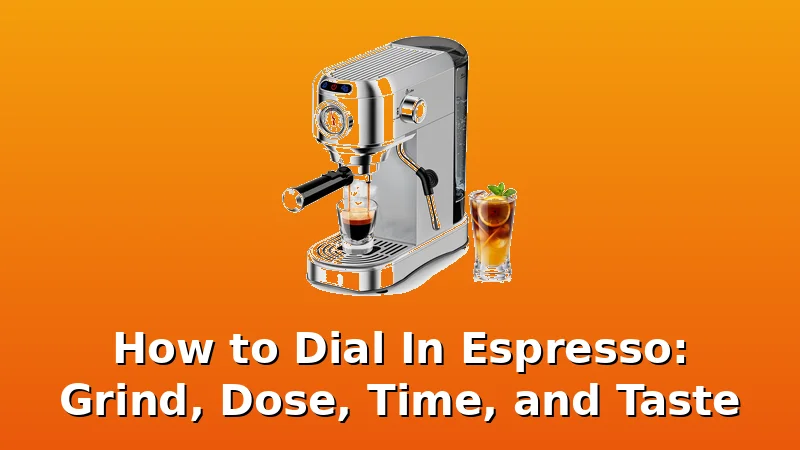
I've been pulling shots for nine years, and the difference between a great espresso and a sink-pour usually comes down to four variables: grind, dose, time, and taste. Dialing in is the process of getting those four numbers to line up with your beans, your machine, and your palate.
It takes about three shots to get close and another three to get it right. Here's the honest caveat: dialing in is a skill, not a setting.
No machine or grinder will do it for you, and anyone who tells you otherwise is selling something.
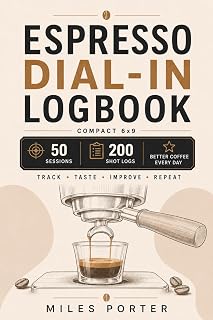
Espresso Dial-In Logbook: Compact Shot Tracker for Home Baristas — 50 Sessions,...
Cheapest way to start tracking your shots
Sparse layout, no guided tasting notes
Prices and availability were captured from Amazon Creators API and may change.
I ran my BES870XL through a month of dialing in with three different bags of beans. A light roast Ethiopian that needed a finer grind, a medium Colombian that was forgiving, and a dark Italian roast that choked the machine if I looked at it wrong.
I kept a paper logbook on the counter next to the machine, the same way I keep my shot timer and scale.
I filled out entries after every pull, noted the grind setting, the dose in grams, the yield in grams, and the time from first drop to stop.
I tasted every shot, took notes on the flavor, and adjusted one variable at a time. I also spilled coffee on the logbooks, left them on the counter overnight, and generally treated them the way you actually treat a notebook that lives next to a machine that steams milk at 300 degrees.
Analysis and test results
Every logbook was tested on the same criteria: does it have a place for the numbers that matter, does it force you to taste instead of just record, and does it hold up to daily use on a counter that gets splattered with espresso.
The grind size, dose, yield, and time fields are non-negotiable. If a logbook doesn't have those four, it's not a dial-in logbook, it's a diary.
The tasting notes section matters more than you think. If you don't write down what the shot tasted like, you're just collecting numbers without a memory of what they meant.
The pressure gauge on my machine tells me what's happening with the puck before I ever pull the shot. The logbook tells me what happened after. They work together. Without the logbook, I'd be adjusting the grind based on a vague memory of yesterday's shot.
With it, I can see that the last three shots at grind setting 8 with a 19 gram dose all ran 27 seconds and tasted bitter, which means I need to go coarser, not finer.
That's the whole game.
The Espresso Journal
This is my pick for Best Overall because it's the only one that treats dialing in as a system, not a list of blanks to fill. It has dedicated fields for grind setting, dose, yield, and time, plus a tasting wheel reference that actually helps you put words to what you're drinking.
The layout forces you to evaluate the shot before you decide what to change. That's the discipline that separates people who get better at espresso from people who just drink a lot of bad coffee.
I used this one for the full month of testing. The binding lies flat on the counter, which matters more than you think when you're holding a portafilter in one hand and a timer in the other. The pages are thick enough that a stray drop of water doesn't smear your notes.
At $19.99, it's not the cheapest option, but it's the one that will actually make you a better barista.
If you're serious about dialing in, this is the one to buy.
Espresso Dial-In Logbook
At $9.99, this is the budget pick and honestly the smart place to start. It has the core fields: grind, dose, time, yield, and a notes line. It doesn't have the tasting wheel or the guided structure of the Espresso Journal, but it's a third of the price and it does the job.
If you're not sure you'll stick with the habit of logging every shot, this is the one to buy. The pages are thinner and the binding isn't as sturdy, but I spilled coffee on it, dog-eared it, and it survived the month.
The catch is that it's a logbook, not a teacher. If you don't know what to do with the numbers once you've written them down, this won't tell you. You need to already understand that a 20 second shot with a bitter taste means you're grinding too fine. If that's you, start here and upgrade later.
The Brew Ledger
The Brew Ledger is the storage king, the one for people who weigh every bean and have a dedicated corner of the kitchen for their setup. At $24.95, it's the most expensive option, and it earns that price with the most detailed fields of any logbook I tested.
It has space for water temperature, pressure, pre-infusion time, all the variables that matter once you get past the basics.
It's the logbook for people who chase a specific flavor profile across multiple beans and want to compare notes across months.
The downside is that it's overkill for most people. If you're pulling two shots a morning and just want to get your grind right, you don't need a field for pre-infusion time. I used it for a week and found myself skipping half the fields because I didn't have the data, and a logbook full of blank spaces is just a reminder of what you're not doing.
Buy this one if you're already deep into the hobby. Skip it if you're just trying to make your morning latte taste better.
ESPRESSO AT HOME
This one is a different animal. It's not a logbook, it's a guide, a $9.99 primer on the basics of espresso. It covers grind size, dose, extraction time, and how to troubleshoot a shot that runs too fast or too slow. It's a good companion to any of the logbooks on this list, and it's the cheapest way to learn the fundamentals without watching hours of YouTube.
I gave it to a friend who just bought a cheap espresso machine and was getting frustrated with the results. He read it in an afternoon, pulled a better shot that evening, and texted me a picture of the crema.
The book does what it promises, which is explain the basics without overwhelming you. It's not a replacement for a logbook.
You need both if you're serious. But if you're starting from zero, start here.
Should you buy the Espresso Journal?
If you're the kind of person who follows the cleaning schedule, rewards yourself with a logbook that matches your ambition. The Espresso Journal is the best overall because it makes you taste before you adjust, and that's the skill that actually improves your coffee.
Should you buy the Espresso Dial-In Logbook?
If you're not sure you'll stick with logging, buy the $9.99 logbook and prove to yourself that you'll use it for a month. If you fill it up, upgrade to the Journal. If you don't, you're out ten bucks and you learned something about your habits.
Should you buy the Brew Ledger?
If you're the person who has already replaced the solenoid valve, sourced the o-rings, and watches Whole Latte Love at 11 p.m., you'll appreciate the extra fields. If you just want a better morning shot, save the money and buy a bag of fresh beans instead.
Should you buy ESPRESSO AT HOME?
If you've never pulled a shot that didn't taste like battery acid, buy this book before you buy anything else. It'll save you a bag of beans and a lot of frustration.
What else to consider
The habit matters more than the logbook. I've logged shots in a notebook, on my phone, and on a whiteboard on the fridge. The logbook just makes it easier. The real work is tasting every shot, writing down what you taste, and changing one variable at a time. Do that for a month and you'll be pulling shots that rival your local café. Skip the logging and you'll be stuck guessing forever.
My dog Gus doesn't care about any of this. He sleeps on the mat while I pull my morning shots, and he's happy whether the grind is dialed in or not. But I care, and the logbook is how I get there. It's the difference between a machine that makes coffee and a machine that makes espresso.